
Gujarat Deputy Chief Minister Harsh Sanghavi has outlined Ahmedabad's vision for the 2030 Commonwealth Games, emphasising unparalleled accessibility for para athletes and a strong commitment to sustainability through green energy and electric transport.
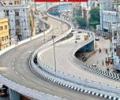
The World Bank on Friday approved loans worth $405 million to promote environment-friendly urban transport projects in Andhra Pradesh.

The Indian government has launched the Urban Challenge Fund (UCF) with a total outlay of Rs 1 lakh crore, aiming to leverage private and market finance for urban infrastructure projects by providing state support in capacity building and credit guarantees.

Mumbai's metro network has expanded with the inauguration of the first phases of Metro Line 9 and Line 2B, promising improved connectivity and reduced travel times for commuters.

Prime Minister Narendra Modi inaugurated the Meerut Metro and Namo Bharat train, enhancing urban and regional connectivity in Uttar Pradesh and Delhi.
Infrastructure major Larsen & Toubro (L&T) reported a 3 per cent year-on-year decline in consolidated net profit for Q4 FY26, reaching 5,325.60 crore, primarily due to exceptional gains in the previous year. Despite this, the company's consolidated order book surged by 28 per cent to 7.4 trillion, with international orders accounting for 52 per cent.

Prime Minister Narendra Modi inaugurates the Navi Mumbai International Airport and a portion of the Mumbai Metro Line, marking significant improvements to transportation infrastructure in Mumbai.

Over the years, India-EU ties have grown, and covered trade, investment, climate change, science and technology, space, digital, mobility, and connectivity.

SmartCity project is in advanced stage.

The temple town is likely to witness a major jump in tourist inflow once flagship projects are commissioned. In the first six months of 2022, more than 20 million tourists visited Ayodhya.
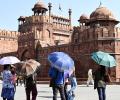
'The intensity and frequency of heatwaves will be much higher than in previous years over Punjab, Haryana, Rajasthan, Gujarat, Madhya Pradesh and Odisha.'

'If weak indicators persist, there is a risk that India could slip into a prolonged slowdown similar to the one experienced between 2014 and 2019,' warns Debashis Basu.
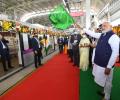
'In the larger cities, we can see that 12%-20% of the population making use of the metros. I don't think it is happening in the smaller cities.'

Each city would get Rs 100 crore (Rs 1 billion) every year.

The new real estate hubs could typically take between 5 and 10 years to develop depending on the state of economy of the city and the state.

'If you align your ambition with India's rise, the peak of your careers will unfold alongside the peak of India's power.'

The Opposition had promised to scrap the Dharavi redevelopment project if it came to power. With the Mahayuti's massive mandate in the Maharashtra assembly election, that prospect has been laid to rest.

Kolkata trams -- now in their 150th year -- are the last to survive modernity in Indian cities, writes Ishita Ayan Dutt.
Against the Reserve Bank of India's (RBI's) projection of 7.1 per cent, India's first quarter (Q1) 2024-25 (FY25) gross domestic product (GDP) growth came in at 6.7 per cent. This is in line with market expectations and significantly lower than the 7.8 per cent recorded in the fourth quarter (Q4) 2023-24 (FY24) and 8.2 per cent in Q1FY24. The quarter witnessed decreased government consumption and investment spending due to the parliamentary election.
Deloitte India on Friday said it estimates India's GDP growth at 6.6 per cent in the current fiscal helped by consumption expenditure, exports rebound and capital flows. In its India's economic outlook report, Deloitte said the rapid growth of the middle-income class has led to rising purchasing power and even created demand for premium luxury products and services. With the expectation that the number of middle-to-high-income segments will be one in two households by 2030/31, up from one in four currently, we believe this trend will likely become further amplified, driving overall private consumer expenditure growth, it said.

100 smart cities to become a reality as Cabinet approves the project, earmarks Rs 100 trillion for the purpose.

Public bicycle-sharing systems are entering this untapped market.

Stocks of public sector undertakings (PSUs) have been on fire in the past year as investors cheered an improvement in key operating metrics and embraced counters of these state-owned enterprises, analysts suggest. The S&P BSE PSU Index has gained over 90 per cent in the past year, rising much higher than the S&P BSE Sensex, which has rose nearly 19 per cent during this period, according to ACE Equity data. The BSE PSU Index, reports show, has delivered a compound annual growth rate (CAGR) of 28 per cent (including dividends reinvestments) over five years and risen by almost 60 per cent in the past year.
'Some districts have said that areas which are away from the urban centres and where there have been minimal to zero Covid-19 cases may be exempted from the lockdown and construction activity should be allowed,' said a person in the know.

Prashant Lingam and Aruna Kappagantula are changing the way houses are being built in India.

Terming investment in infrastructure "quintessential" to boost growth, the Economic Survey on Friday said post unlocking of the economy, infra sectors are poised for growth and construction of roads is expected to return to the high pace attained before COVID-19. The infrastructure sector will be the key to overall economic growth and macroeconomic stability, the Survey said emphasising that the year after the crisis (2021-22) will require sustained and calibrated measures to facilitate the process of economic recovery and enable the economy to get back on its long-term growth trajectory. "Basic infrastructure facilities in the country provide the foundation of growth. In the absence of adequate infrastructure, the economy operates at a suboptimal level and remains distant from its potential and frontier growth trajectory.

The Centre on Monday earmarked a separate Rs 2,217 crore for 42 urban centres to tackle air pollution and announced the much-awaited voluntary vehicle scrapping policy to phase out old and polluting vehicles, even as it shrunk the budgetary allocation for the environment ministry from the last fiscal by nearly eight percent. Union Finance Minister Nirmala Sitharaman, in her budget speech for 2021-22, announced a total of Rs 2869.93 crore for the ministry, Rs 230 crore less than the last fiscal. Officials said the outlay has been lesser this time as the economy is recovering from the COVID-19 pandemic.

L&T is the preferred pick, but given the opportunities in the power T&D space analysts are also positive on KEC, ABB and Kalpataru
Smart cities must be very well equipped with technology and security systems alike.

'People will say a lot of things -- ignore the noise.'

Long-term funding was a requirement for infrastructure projects, and asset-liability mismatch in the banking system, impacts the access to finance for infrastructure projects. One of the key challenges would, however, be to get private sector back into investing.

'This (opposition to the project) is not just architects, but everyone needs to know more.' 'We need to be allowed to participate, maybe, you can ignore what we have to say, that's your decision.' 'At least follow the process.
These smart cities should have the capacity to absorb, adapt and provide opportunities for both the poor rural migrants as well as the educated professionals, say Sujit K Pruseth & Sachi Satapathy.

Finance Minister Nirmala Sitharaman on Tuesday unveiled a Rs 39.45 lakh crore Budget with a view to fire up the key engines of the economy to sustain a world-beating recovery from the pandemic. This was Sitharaman's fourth Budget. While the taxpayers were left in the lurch, once again, was she able to cheer Corporate India?

India's current growth rate is 7.5 per cent.

'The telecom companies are our lifeline now, despite having nearly collapsed under debt because of ill-advised policies.' 'Perhaps our obvious dependence on telecom services will spark well-conceived policies for this sector,' says Shyam Ponappa.

Finance Minister Nirmala Sitharaman on Monday presented the Budget for 2021-22 in the Lok Sabha that is expected to provide relief to the pandemic-hit common man as well as focus more on driving economic recovery through higher spending on healthcare, infrastructure and defence amid rising tensions with neighbours, As India emerges from the COVID-19 crisis, the ninth Budget under the Modi government, including an interim one, is widely expected to focus on boosting spending on job creation and rural development, generous allocations for development schemes, putting more money in the hands of the average taxpayer and easing rules to attract foreign investments.

India will need an annual investment of Rs 15 trillion in infrastructure over the next five years, says Chandrajit Banerjee, DG, CII.

US Ambassador Richard Verma's tips to the Indian states.

Like Jamshedpur, many Indian cities that have been and will be properly planned can be smart cities of the future.
